
The Mauritian sun is more than a tourism asset; it is a massive, untapped bank account for homeowners struggling under the weight of rising utility costs. In our small island economy, where energy prices remain sensitive to global volatility, the "Dilemma" of staying tethered to the traditional grid is becoming a pressing financial math problem. We have crunched the latest economic data to determine if residential solar is a genuine fiscal win or merely a green aspiration.
The Standard Entry Point: MUR 3.5 to 4.5 Lakh
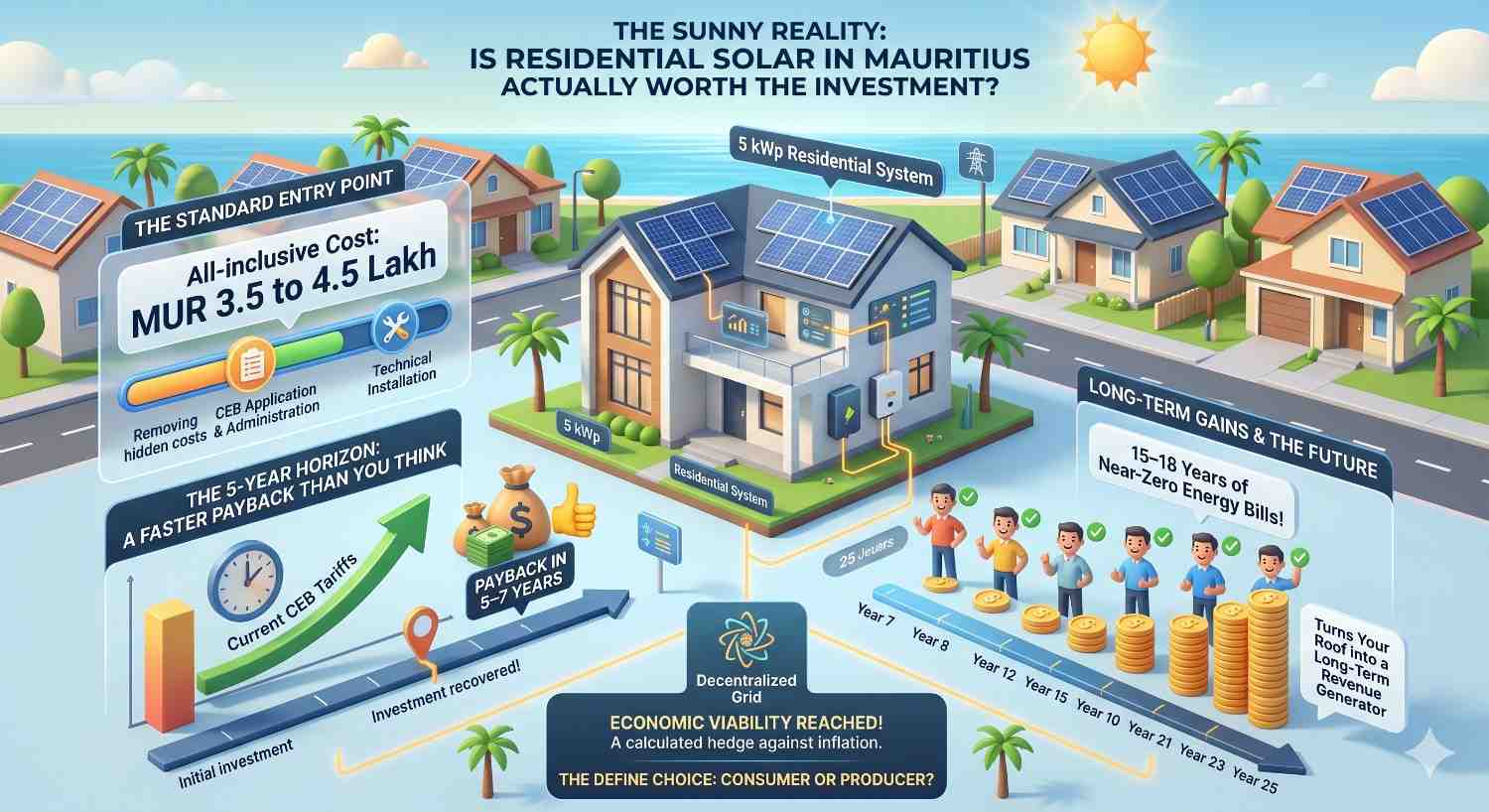
The primary barrier to entry has long been the perceived "sticker shock" of the initial installation. However, current market data provides a concrete baseline for a 5 kWp residential rooftop system, which serves as the standard for most Mauritian households.
Crucially, this figure is a comprehensive "all-in" price. By including the technical and administrative hurdles of the CEB application process, this pricing model removes the "hidden cost" fears that often paralyze potential investors.
"For a typical 5 kWp residential rooftop system, the all-inclusive cost in Mauritius ranges from MUR 3.5 to 4.5 lakh including CEB application."
The 5-Year Horizon: A Faster Payback Than You Think
From a fiscal standpoint, the most compelling argument for solar isn't the environmental footprint, but the speed of the break-even point. Recent implementation data shows that the path to pure profit is surprisingly short, often outperforming traditional long-term savings accounts.
"Payback is 5–7 years against current CEB tariffs."
The real win, however, lies in the decades that follow this initial window. While the system pays for itself within seven years, these installations typically boast a lifespan of 20 to 25 years. This means a homeowner can enjoy approximately 15 to 18 years of near-zero energy bills, effectively turning their roof into a long-term revenue generator.
The Future of the Mauritian Roof
The economic viability of solar in Mauritius has reached a clear tipping point. With a transparent upfront cost and a rapid 5-to-7-year return on investment, the transition to renewable energy is now a calculated hedge against inflation.
As we look toward a more decentralized grid, every homeowner faces a definitive choice. Is it more beneficial to remain a lifelong consumer of energy, or to seize the long-term financial freedom of becoming a producer?