
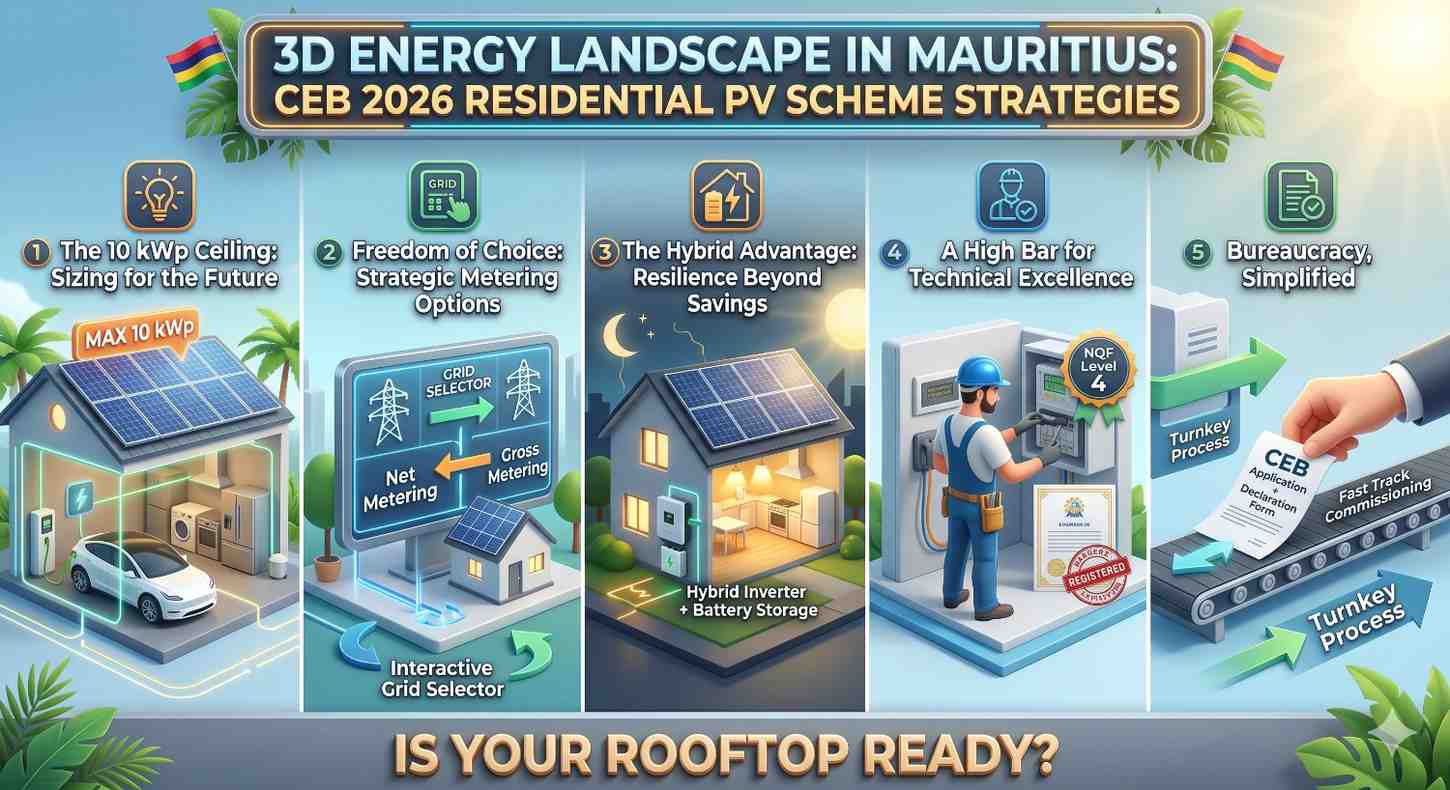
The energy landscape in Mauritius is currently navigating a watershed moment. With the launch of the Central Electricity Board (CEB) 2026 residential PV scheme, the government isn't just offering a subsidy; it is signaling a structural shift in how our island powers itself. For the savvy homeowner, this represents a finite window of opportunity to pivot from being a passive consumer to an active "prosumer." As a strategy consultant in this space, I see this as the most coherent roadmap yet for those looking to decouple their household finances from rising utility costs.
Below are the five strategic takeaways you need to understand to navigate this transition effectively.
1. The 10 kWp Ceiling: Sizing for the Future
The CEB 2026 scheme establishes a system capacity limit of 10 kWp for residential installations. While this may seem like a technical detail, its significance lies in "future-proofing." A 10 kWp threshold is remarkably generous for the average Mauritian household, which typically consumes far less.
The strategic play here is not just meeting today’s lighting and air conditioning needs, but preparing for the inevitable "mobility transition." As Electric Vehicles (EVs) become the standard on Mauritian roads, your rooftop will effectively become your personal petrol station. Sizing your system toward this 10 kWp ceiling today ensures you have the "grid-edge" capacity to fuel your home and your transport for the next decade.
2. Freedom of Choice: Strategic Metering Options
The framework introduces a critical level of flexibility by allowing homeowners to choose their financial relationship with the grid.
"Net metering or gross metering option."
As a consultant, I advise looking at this choice through the lens of your long-term goals. Net Metering is the "self-consumption" play—it’s ideal for those who want to use their solar power in real-time to zero out their monthly bills. Gross Metering, conversely, is often a "financial play," where all generated energy is exported to the grid at a fixed rate. This choice allows you to tailor your solar investment to either immediate cash-flow relief or long-term asset yield.
3. The Hybrid Advantage: Resilience Beyond Savings
One of the most transformative elements of the 2026 scheme is the explicit inclusion of the hybrid PV and battery option. Most homeowners are surprised to learn that standard grid-tied solar systems actually shut down during a power cut to protect utility workers.
The hybrid option changes the value proposition from simple cost-reduction to absolute energy sovereignty. By integrating battery storage, your home gains "outage protection," ensuring that when the local grid falters, your lights, refrigeration, and security systems remain operational. In an era of increasing climate volatility, this resilience is no longer a luxury—it is a critical residential asset.
4. A High Bar for Technical Excellence
To protect the integrity of the national grid and the safety of residents, the CEB has moved solar away from "handyman" territory and toward rigorous professional engineering standards.
"Installer must be MARENA-registered with NQF Level 4 electrician."
This requirement is a massive win for the consumer. Mandating an NQF Level 4 qualification ensures that your installation meets international safety standards, which is a prerequisite for insurance coverage and long-term hardware warranties. It transforms a solar installation from a "hardware purchase" into a certified infrastructure project, protecting your investment for its 25-year lifespan.
5. Bureaucracy, Simplified
Historically, the "administrative maze" of the CEB has been the single greatest deterrent for solar adoption in Mauritius. The 2026 scheme, when executed through professional partners like Sunmaster, finally addresses this friction.
Sunmaster has effectively commoditized the bureaucracy. By bundling the full CEB application, the mandatory Rs 2000 application fee, the complex Declaration Form, and the final commissioning into a single, fixed-price quote, they have removed the traditional pain points. This turnkey approach allows homeowners to focus on the technical performance of their system rather than chasing paperwork through government offices.
Conclusion: A Sun-Powered Outlook
The CEB 2026 scheme is a catalyst that fundamentally redefines the Mauritian energy landscape. By balancing high technical standards with the flexibility of battery storage and intelligent metering, the government has cleared the path for true residential independence. As we move toward a decentralized energy future, one question remains for every property owner: Is your rooftop currently a dormant liability, or is it an untapped powerhouse waiting to be activated?