
Beyond the Duck Curve: Why the 'Butterfly' Canopy is the Grid’s New Best Friend
As solar energy installations sweep across agricultural landscapes, a quiet tension is reaching a breaking point between renewable energy developers and Power Distribution Companies (DISCOMs). For the utility engineer, standard ground-mounted solar is no longer just a success story—it is a looming operational headache. The culprit is the "Duck Curve," a phenomenon where a massive spike in midday solar generation floods the grid precisely when demand drops, followed by a gut-wrenching "evening ramp" as production vanishes just as households power up. This imbalance is more than a technical glitch; it is a threat to grid stability. However, a new architectural shift known as "Butterfly AgriVoltaics" is transforming this relationship, evolving from a utility competitor into a 24-hour operational lifeline.
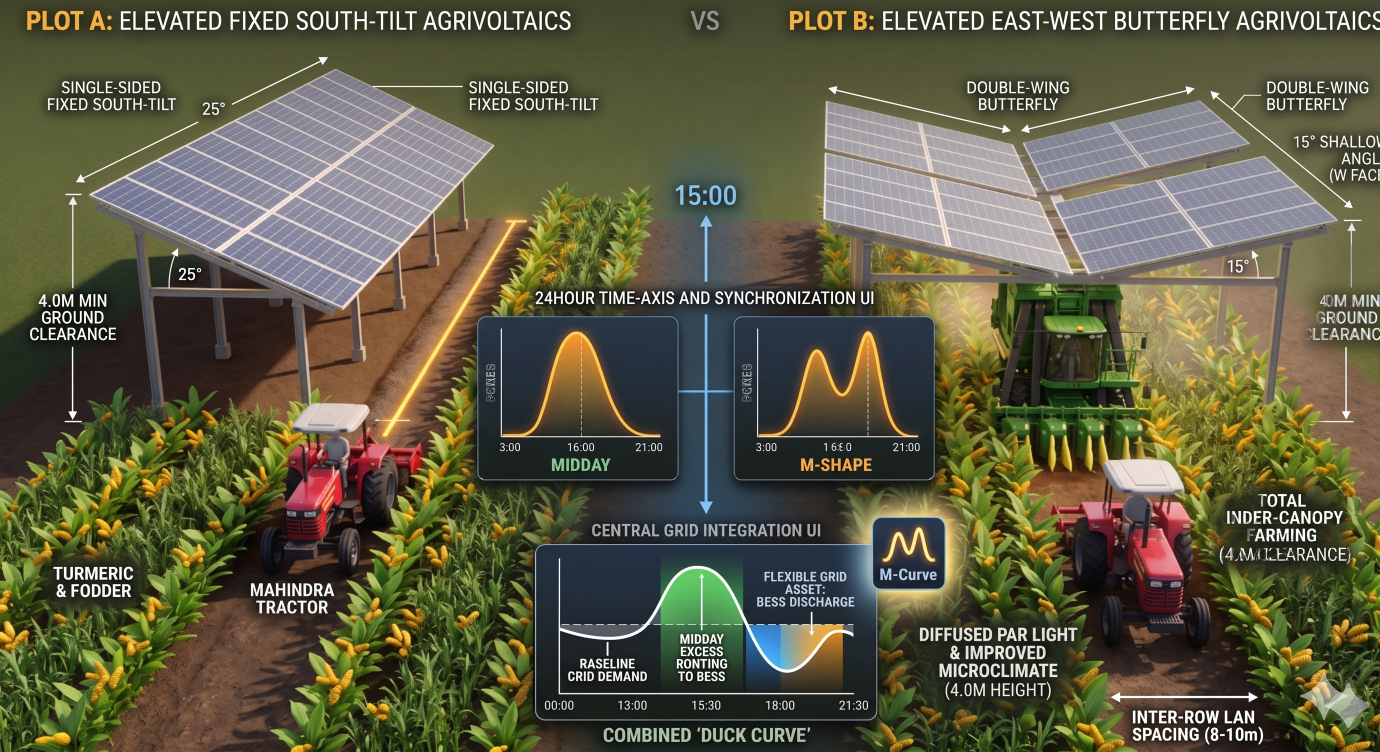
The "M-Curve" is the New Shape of Solar Success Traditional solar arrays face South to maximize raw exposure, while some newer AgriVoltaic designs utilize vertical "fences" running North-South. The evolutionary leap, however, is the East-West "Butterfly" orientation. By capturing morning light with East-facing wings and late afternoon sun with West-facing ones, the system replaces the volatile midday spike with a twin-peak "M-Shape" power curve. This intentional "dip" at solar noon is a strategic masterpiece for grid health. Instead of aggressively dumping power into the grid and risking voltage surges that strain local substations, the Butterfly design provides a tempered, steady flow that eradicates the overgeneration risk.
The 3-Meter Lift that Saves the Farm The physical innovation of this model, showcased in successful reference pilots like the one in Issapur, centers on elevating the canopy on stilted structural columns to a height of 3 meters. This clearance is the magic number that enables "100% Machine-Mechanized Farming," allowing standard tractors to drive, till, and harvest directly underneath the panels. This setup creates a "moving checkerboard of partial shade" that protects high-value, shade-loving crops like turmeric or fodder from midday heat stress, ensuring that land remains a primary agricultural asset while doubling as a power plant. This architecture effectively ends the era of compromise:
"For generations, farming and power generation were treated as an 'either/or' choice. If you wanted solar, you sacrificed food security; if you wanted green power, the DISCOM had to absorb a volatile generation curve."
Solving the Grueling "Evening Ramp" The hardest part of a DISCOM manager's job is navigating the 6:00 PM to 9:00 PM window. As solar generation hits zero, demand skyrockets, forcing utilities to buy expensive peak power from coal or gas plants. The Butterfly AgriVoltaic model, when paired with Battery Energy Storage Systems (BESS), creates a "dispatchable profile" that solves this infrastructure headache through a specific 24-hour symbiosis:
- Late-Day Capture: West-facing panels continue generating power significantly later into the afternoon than South-facing arrays.
- Strategic Buffering: Any midday excess produced during the "M-Curve dip" is routed directly into on-site, containerized BESS.
- Peak Flattening: The stored reserves are discharged into the grid precisely from 18:00 to 21:00, providing a grid savior exactly when the Duck Curve is at its most dangerous.
A Localized Cure for Infrastructure Headaches Beyond the curve, these localized AgriVoltaic assets offer a massive economic reprieve for utility business models. Traditional remote solar farms require millions in capital expenditures to upgrade substations and high-voltage transmission lines to move power across long distances. In contrast, Butterfly systems feed clean, predictable power directly into the lower-voltage distribution grid at the exact point of consumption. By reducing the physical strain on the network and avoiding costly upgrades, these installations move from being "threats" to traditional revenue to becoming essential grid assets.
Conclusion: From Raw Capacity to Predictable Flexibility The Elevated Butterfly model shatters the old narrative that we must sacrifice food for green power or grid stability for renewable growth. By preserving agricultural productivity and providing a smooth, dispatchable power profile, it shifts the focus from the quantity of energy to the quality of the grid connection. As we move toward a more complex energy landscape, we must ask:
What are your thoughts on shifting grid metrics from raw capacity (MW) to predictable flexibility?