
Harvesting the Sun Twice: How Mauritius is Redefining the Future of Farming
For an island nation like Mauritius, every hectare is a high-stakes negotiation. There is a palpable tension between the turquoise coastlines that drive tourism and the emerald sugar fields that have long defined the economy. In this zero-sum game of land use, the demand for renewable energy and the necessity of food security have historically been at odds. However, a new paradigm is emerging: agrivoltaics. By integrating energy production and agriculture on a single plot, Mauritius is moving beyond the "food vs. fuel" binary to a future where both coexist in a high-tech symbiosis.
The Regulatory Engine: Inside the CEB CAV II Scheme
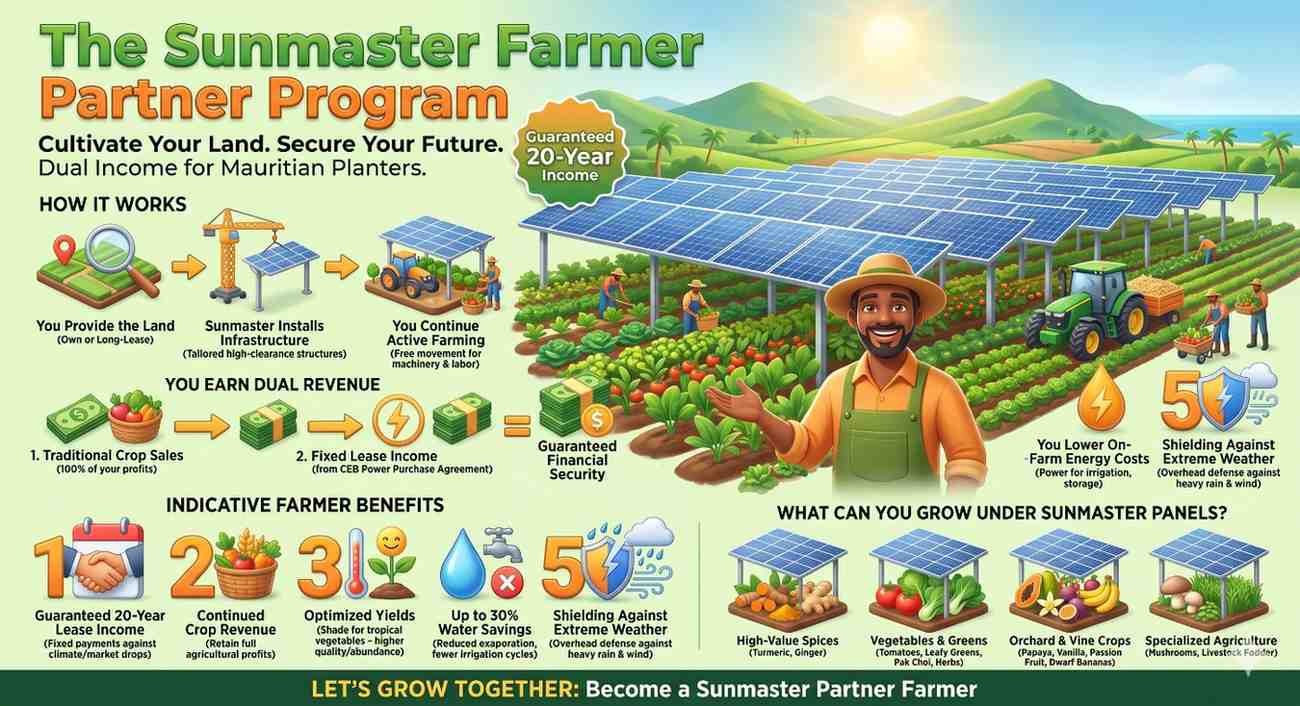
The catalyst for this transformation is the CEB CAV II scheme, a state-backed regulatory framework that provides the legal and technical certainty required for such radical infrastructure. Unlike traditional ground-mounted solar farms that effectively sterilize the soil beneath them, this scheme mandates the use of "raised solar structures."
These are not merely tilted panels; they are sophisticated engineering feats elevated high enough to allow for human labor and even tractors to operate underneath. From an economic perspective, a state-backed scheme like CAV II is the essential "de-risking" mechanism that permits institutional investors and farmers to collaborate on complex, multi-use land projects that would otherwise be stalled by bureaucratic ambiguity.
The 8 MWh Milestone: Decoupling Sunlight from Stability
A flagship example of this evolution is the project currently being spearheaded by Sunmaster Mauritius. The technical specifications are impressive—4 MW of power generation capacity—but the real story lies in the 8 MWh of battery storage.
For an island grid, intermittent solar energy can be as much a liability as an asset. The 8 MWh battery system is the lynchpin of grid stability, transforming erratic, weather-dependent solar into "dispatchable" power. By capturing energy during the peak of the tropical day and discharging it when the grid requires it most, Sunmaster is proving that agrivoltaic farms can be just as reliable as traditional power plants, while the land remains productive for the agricultural sector.
Asset Optimization: The Dual-Income Revolution
From the perspective of an economic analyst, agrivoltaics represents a fundamental shift in the "P&L" of the modern farm. It introduces a dual-income model that turns the traditional farm into a diversified asset class. By securing a long-term Power Purchase Agreement (PPA), farmers gain a hedge against the inherent volatility of the agricultural market.
"Farmers receive long-term land lease income from the PPA revenue while continuing to farm shade-tolerant crops underneath the panels."
This model is a masterclass in asset optimization. The PPA provides a predictable, long-term cash flow—a financial baseline that effectively subsidizes the higher risks associated with farming. In essence, the energy revenue de-risks the agricultural operation, providing a safety net that protects the farmer from fluctuating commodity prices and erratic weather patterns.
The Symbiosis of Shade and Soil
The agricultural side of this equation requires a strategic pivot toward shade-tolerant crops. The raised structures create a unique microclimate that can actually benefit certain cultivars by reducing water evaporation and protecting plants from the punishing intensity of the midday tropical sun.
This is land efficiency in its purest form. By utilizing the vertical space above the crops, Mauritius is turning a single plot of land into a multi-functional asset. The energy and food sectors are no longer competing for the same square meter; instead, they are engaged in a symbiotic relationship where the infrastructure for power also serves as the canopy for cultivation.
Beyond the Horizon: A Blueprint for Land Collaboration
The success of the CEB CAV II scheme and the Sunmaster project offers a new blueprint for land use that resonates far beyond the shores of Mauritius. It challenges the global assumption that we must choose between energy independence and food security.
As we look toward a future where land scarcity will only intensify, the Mauritian model demonstrates that the solution lies in collaboration, not competition. By redefining the relationship between the sun, the soil, and the grid, Mauritius is showing the world how to harvest the sun twice. The question now for other land-constrained regions is no longer "if" they can adopt this dual-income model, but how quickly they can implement the regulatory framework to make it a reality.